
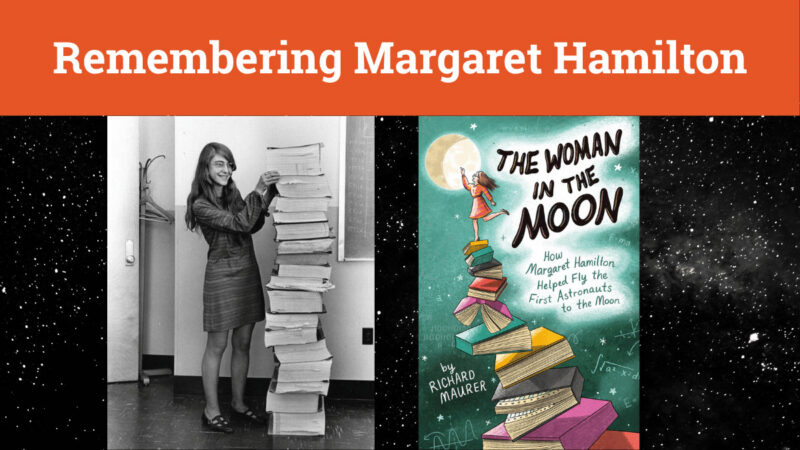
We honor the legacy of mathematician and software engineer Margaret Hamilton (1936-2026), whose life’s work is featured twice in the New York Times this month:
Margaret Hamilton, who led the 100-person team that wrote the onboard software for the Apollo missions, guiding Neil Armstrong and Buzz Aldrin to a safe landing on the moon, died on Sept. 30 in Cambridge, Mass. She was 90.
Ms. Hamilton was a young mathematician at the Massachusetts Institute of Technology in the early 1960s, putting her husband through law school by working in a computer lab. When she learned that M.I.T. was designing in-flight computers for the moon mission, she eagerly joined the team.
She was the first female programmer hired to work on the Apollo project, housed at M.I.T.’s Instrumentation Laboratory, in 1965. Her skills led to her promotion to director of software engineering on the project, which developed the two 70-pound onboard computers for the Apollo flights: one in the command module, which carried the astronauts from Earth, and the second in the lunar module, which set down on the moon’s surface.
Ms. Hamilton, who would bring her young daughter to work on weekends and evenings, is credited with popularizing the term “software engineering” to describe the complexity of the work her team did, thus elevating software coding to a status equal to hardware design.
– The Woman Whose Software Guided the Apollo Missions Has Died, New York Times, October 7, 2026
Young people can learn about Margaret Hamilton’s work in the 2026 Mathical Honor Book, The Woman in the Moon: How Margaret Hamilton Helped Fly the First Astronauts to the Moon, by Richard Maurer.
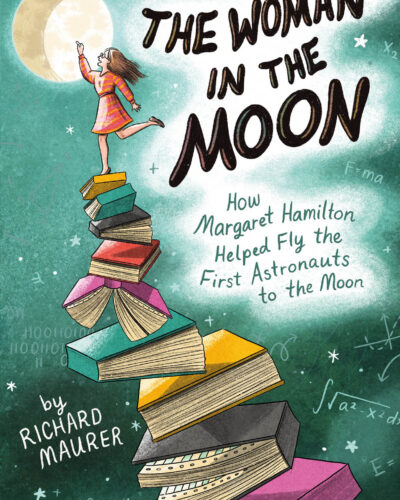
The Woman in the Moon
2026 Mathical Book Prize Honor Book for Grades 6-8 / Ages 11-13
PBS News Hour has also shared a short video about her (via YouTube).